If you've sat through a board meeting, you've probably seen an S-curve on a slide. Most marketing plans have a funnel in them somewhere. They're worth knowing. They also leave a lot out.
The S-curve of growth
In 1962, Everett Rogers published Diffusion of Innovations, a book about how new ideas and products spread. When people take up something new, the number who have it rises slowly, then quickly, then levels off. Plot it over time and you get an S. Televisions, dishwashers and air conditioners all spread through homes that way.
Companies borrowed the shape to plan growth. A launch starts slow, takes off, then hits a plateau, and the plan is to find the next curve before this one flattens.
The curve shows what happened to sales. It doesn't show why they slowed, so it can't tell you what to fix.
The marketing funnel
The funnel goes back to around 1900, to an advertising formula usually credited to E. St. Elmo Lewis. A good ad, the formula said, gets attention, builds interest, creates desire and asks for action. Marketers shortened it to AIDA. Today most teams boil it down to three stages: aware of you, considering you, buying from you.
How do you identify a person at a point on their belief system and try to categorize that? Are they aware of me? Are they considering me? Are they purchasing me?
The reality is they aren't. They're way outside of that.
That's the point of my framework: to adopt what Eugene Schwartz looks at, from the unaware to the problem aware. Well, what does that mean?
Automatically, we need to shift our perspective from "Do people care about my business?" to "Do I care about people? What do people want?" When you realize that, it eliminates the need to understand the S-curve of growth as a theoretical device.
Businesses continually miss the mark
What it does instead is illustrate all of the ways that businesses continually miss the mark on meeting the needs of the market, whether that is the product or the way that they talk about the product.
If I'm selling something that is full of jargon, highly technical, I can sell it in the worst way possible. I can say these loudspeakers are made of solid mahogany wood, with six-and-a-half-inch driver cones and a frequency response of 30 to 22,000 Hz.
That doesn't mean anything to people, unless you're just a completely mentally ill audiophile like me.
Instead, I need people to understand: when you have a sound bar and it's sitting on a table, it gets very boomy. The reason for that is the sound's just hitting the table, it's hitting the wall, it's hitting everything around it. It's trying, in a very small space, to make a very big sound.
Every time you're doing that, it compromises. You're not just compromising on a look or aesthetic. That is a big trade-off. If you don't love the big speakers, you're going to need something else that is less conspicuous. That doesn't mean you need to lean into a small, compact sound bar that's going to be sending sound every direction, including where you don't want it.
When that happens, sound waves cancel each other out. All that means for you is you're going to have to turn the volume up louder to hear it if you're sitting in front of it. But the rest of your house is going to hear it too, and they're not going to hear it very clearly. They're just going to be annoyed. They're going to feel the bass. They're going to feel all these different sounds coming in when they're just trying to focus and read a book.
So if you want something to bring you into the action, to bring you into the game, to make it easier to hear who's coming after you or to feel like you're in the stadium, there's nothing that's going to beat the big box speakers and the traditional surround sound system. Nothing's going to come close. But if you want something in between, here's what I'd recommend.
Do you see what I mean? That's helping to offer and communicate to the market exactly what it is they understand and what they want.
Someone else has done the work of educating them
Versus: here's all the features and specs. You go do the homework. If you don't understand what that means, come back to me when you do.
Well, by the time they've figured out what that means, someone else has done the work of educating them. The person who's educated them, who's taken them from point A to point B in their understanding, is now going to own points B to C, C to D, D to E. They've earned trust. They earned trust because they started by understanding: hey, this is your problem. You've got these symptoms. You've got these issues. Let me help diagnose them.
When that person gives them options, that person feels less biased. That person feels more trustworthy and reliable, because they're not pushing them toward any single solution. They're giving them an idea of what solutions could work and helping them balance trade-offs and insights.
Basically, we do the thinking for them.
By the time they've consumed the content, they feel like they've done all the thinking, because they've read about it, and they feel smarter for having done so.
Without all of that, you get an S-curve
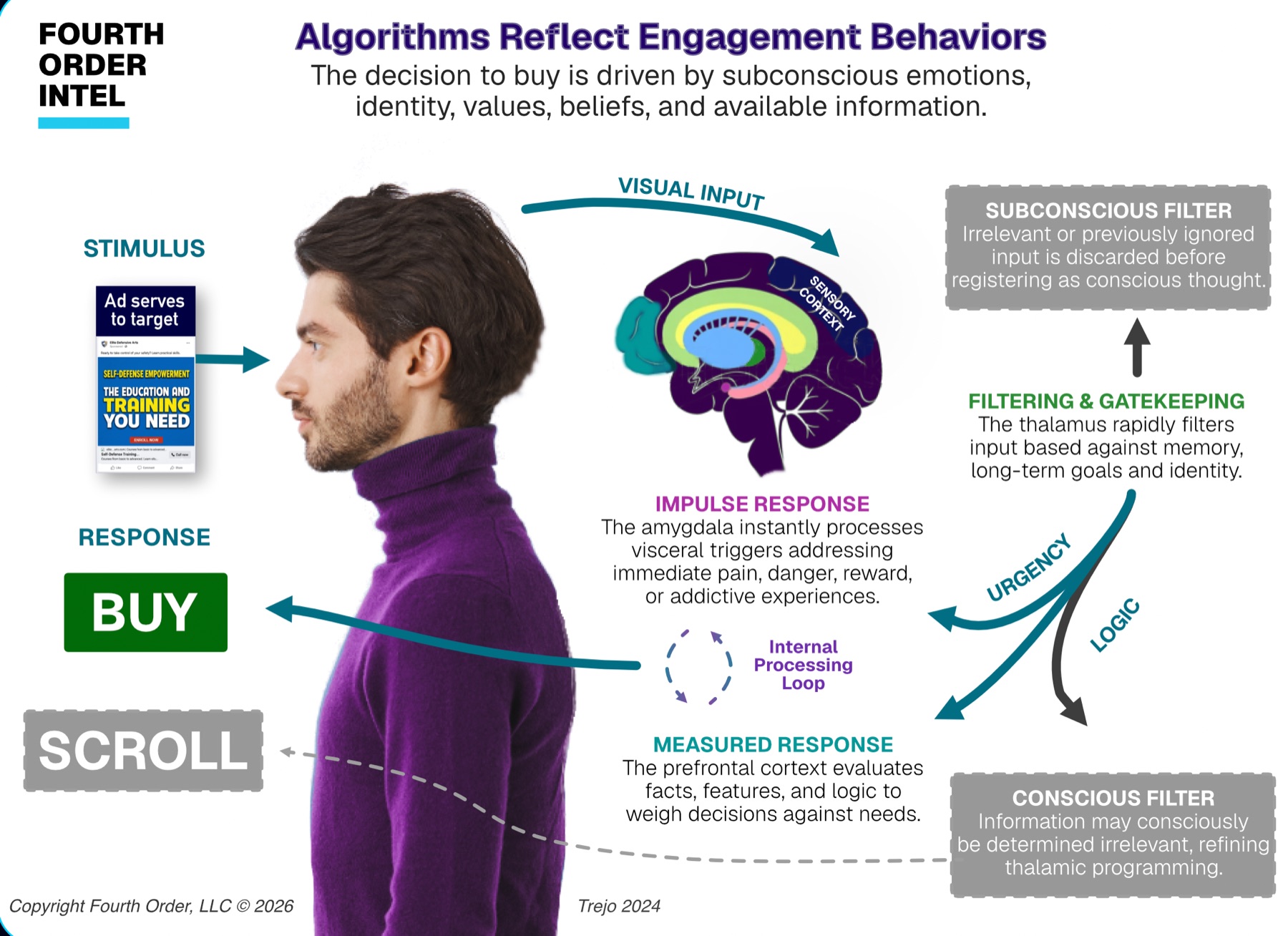
You get less demand, you get less traffic, you get less engagement. Because people don't understand what it is you're even saying, they automatically ignore it. The thalamus is literally filtering it out.
Porter's Five Forces
In 1979, a Harvard Business School professor named Michael Porter asked why some industries make more money than others. His answer was five forces: how hard competitors fight each other, how easy it is for new companies to get in, how much say buyers and suppliers have, and how easily customers can switch to something else.
The Business Model Canvas
In 2010, Alexander Osterwalder and Yves Pigneur published the Business Model Canvas in their book Business Model Generation. It puts a whole business on one page: nine boxes, from who your customers are to how you make money. Strategyzer, the company Osterwalder co-founded, publishes it. You fill it in during planning, and it shows the business as it stood that day.
Why these models break down
The reality is there are forces acting on your business at all times. That's what Porter's Five Forces and Continuous Market Fit are trying to answer.
So why is Porter's Five Forces not enough? Why is the Business Model Canvas not enough? Why are these static Strategyzer tools not enough?
They're a good thought exercise. But if you really want to build a data model that keeps you resilient, you need to think about all of these forces and how they work together.
That's why this framework matters
This framework has Porter's Five Forces. It has Maslow's hierarchy of needs. It has an identity ladder. It helps us understand how people want to be seen, and what their beliefs and values are.
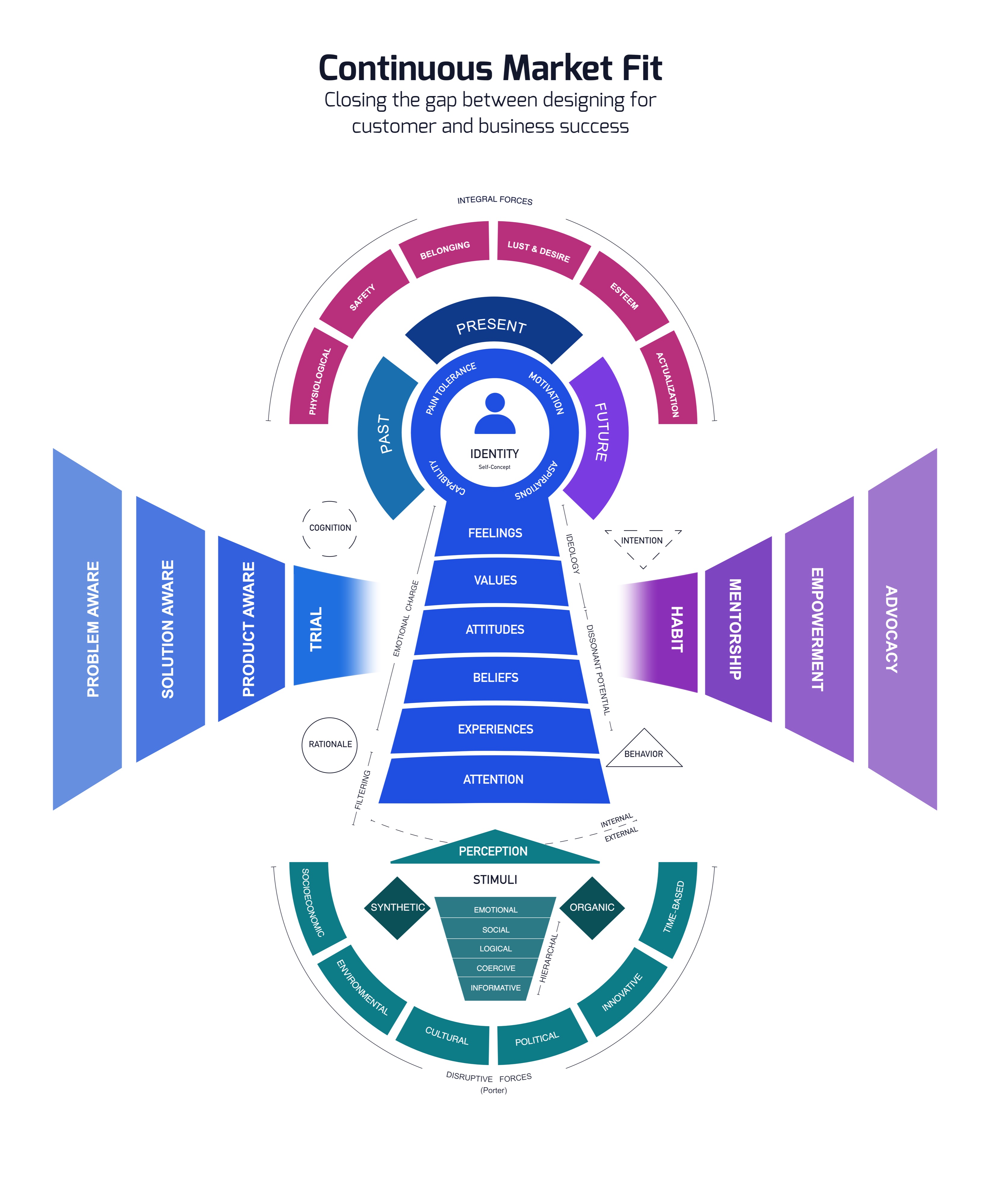
Well, it's a model, and like all models, it's incomplete. How do you complete it? You go out and you get to know people. You do research on SEO and usability. You look at what people are searching for and what they're saying to their chatbots. Fortunately, we're getting more transparency on that, so that we can actually use it.
Even our model only represents the types of data we capture in a continuous cycle, so that we can be aware of what's going on.